Cranium Overview
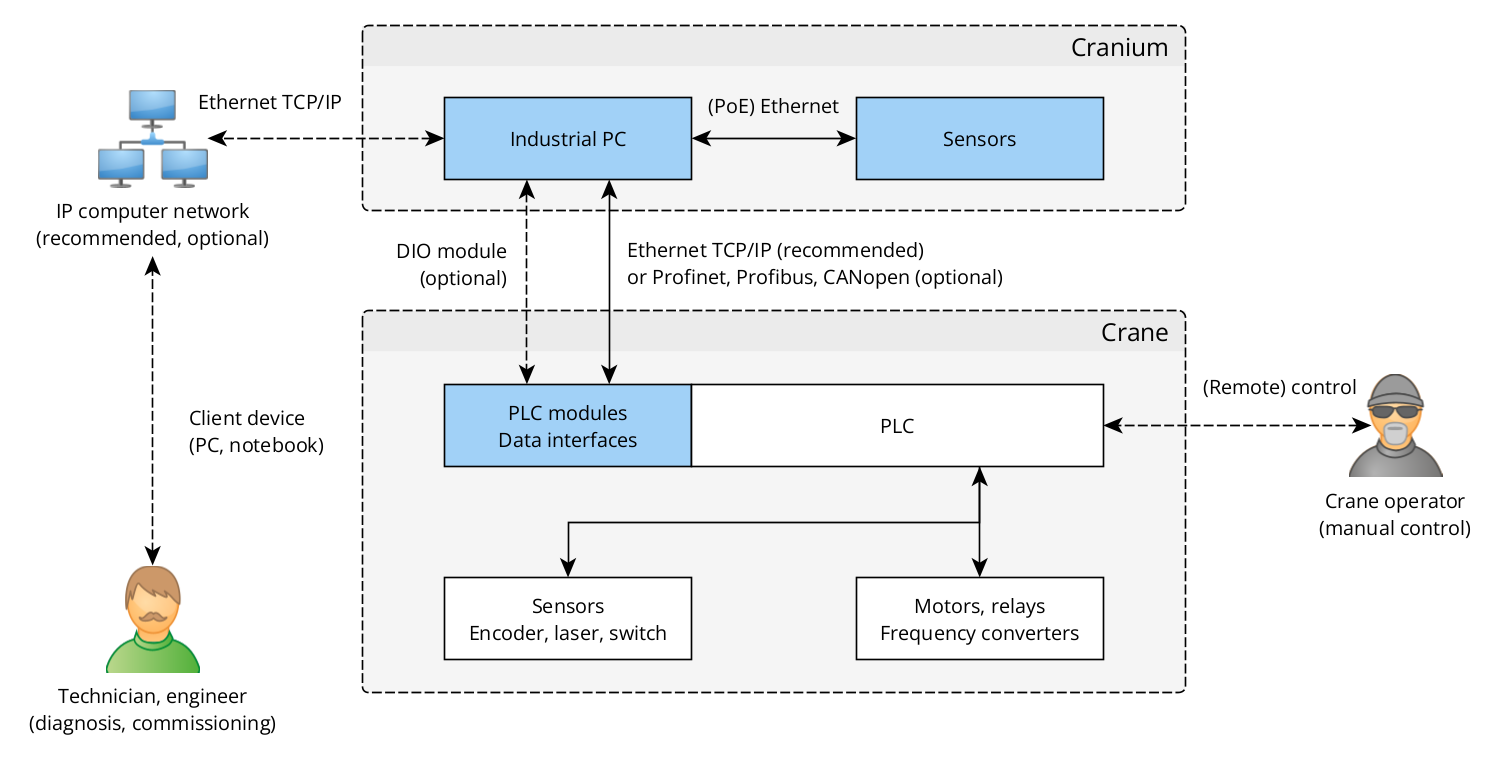
The functional scope of Cranium can be optimally adapted to your crane system. To this end, the system follows a modular concept, which is shown schematically in the following overview. However, the specific structure depends on the crane and can vary greatly. The interfaces between the components depend on the desired modules and functions implemented with Cranium.
Industrial PC
The system's foundation is the industrial PC. Cranium combines modern, embedded computing technology with fine-tuned firmware and software. Different interfaces are available for integration into the system, depending on the application. The TCP/IP protocol connects the crane PLC in the standard case. One of the supported fieldbus technologies can also be used if necessary. In some instances, it can also be more straightforward: For example, connecting simple digital inputs and outputs to the PLC is sufficient to implement gantry track monitoring with proximity sensors.
PLC Integration
For most of our functions, such as electronic pendulum damping (anti-sway) and automatic path following, the Cranium data interface is implemented in a PLC module via TCP/IP. The scope and content of the data can vary depending on the desired functionality. In addition, our system requires the position data from the crane's gantry, trolley, and hoist for some automatic functions. The associated sensors, like encoders or laser systems, are often connected to the crane PLC so that this data can be transferred directly to Cranium.
For the connection with TCP/IP, we supply PLC modules for Siemens and Codesys as examples. Our engineers also provide comprehensive support with the necessary PLC programming.
Sensors
Cranium requires additional measurement technology for demanding applications, such as diagonal pull prevention and dynamic obstacle avoidance. Depending on the application, we offer specialized devices: Camera, laser, lidar, and inductive sensors. Most of our sensor systems are connected to the IPC via Ethernet. Some sensors, such as the camera, can alternatively be operated directly via the IPC using PoE. For more complicated scenarios that require modern optical sensors, such as multi-layer lidar, we provide support before and during a project in determining the appropriate attachment. For this purpose, we simulate and visualize the crane system and associated processes to determine the installation's optimum position and orientation.
Configuration
The system is commissioned via the integrated web application after all components are correctly installed and the crane PLC is prepared accordingly. You only need to connect a computer directly to the IPC via an Ethernet cable and access the Cranium web application with an up-to-date browser. The web interface provides detailed status information, wizards, and preferences for setting up the applied modules. The system's firmware and software can also be updated via this application, or new functions can be licensed retrospectively.
We recommend integrating the IPC into a computer network that enables remote access if required. This setup allows the system to be diagnosed and troubleshot remotely in an emergency. We also offer support for WireGuard as a VPN solution.
Operation
The system's operation depends on the specific modules and utilized functions. If, for example, the system is only used for electronic pendulum damping (anti-sway) or static obstacle management, the actual operating controls do not change for the crane operator. After integration with the crane PLC, the assistance system works automatically during manual operation. Other functions, however, such as diagonal pull avoidance or following stored paths, require it to provide corresponding operating controls to activate the respective functions. For example, appropriate switches can be provided on a remote control to teach in positions or start automatic travel.